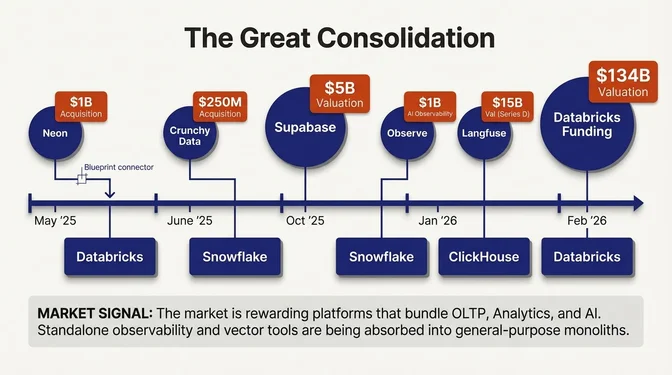
Databricks spent $1 billion on Neon. Snowflake grabbed Crunchy Data for a reported $250 million. Supabase went from a $2 billion to $5 billion valuation in four months. 2025 had one thesis: PostgreSQL wins.
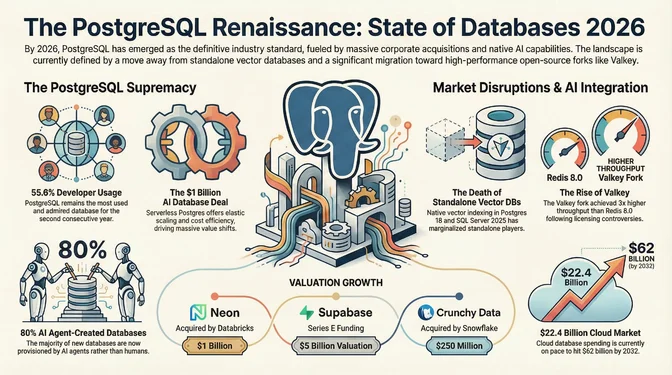
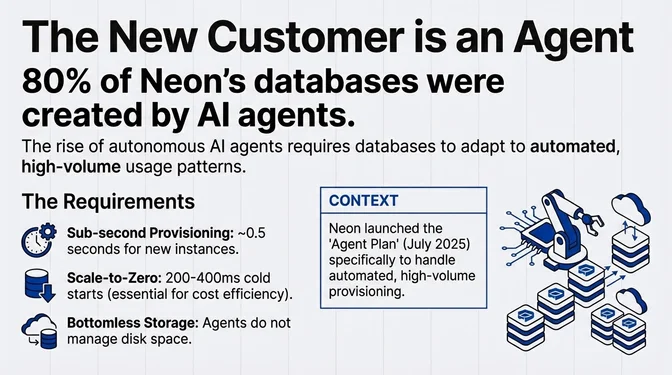
The numbers back it up. PostgreSQL hit 55.6% usage in Stack Overflow’s 2025 Developer Survey, making it the most used and most admired database for the second year running. It now powers Databricks’ new Lakebase and Amazon Aurora DSQL; even Turso’s $4.99/month edge databases run on Postgres. AI agents created over 80% of Neon’s databases, not people.
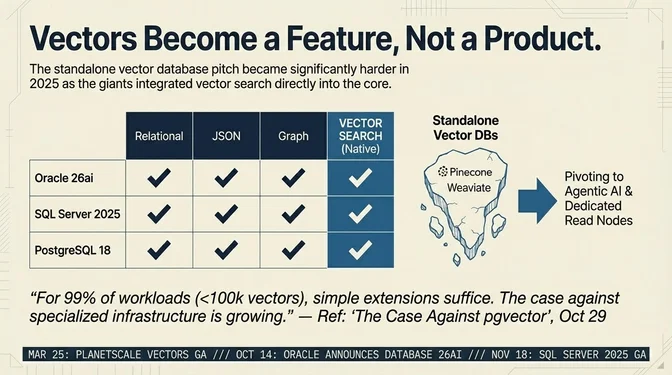
PostgreSQL 18 shipped vector search through pgvector. Oracle rebranded its database “26ai” and bundled it free. SQL Server 2025 added DiskANN indexes. When three of the biggest database platforms ship the same feature in one year, the standalone vector database pitch gets a lot harder.
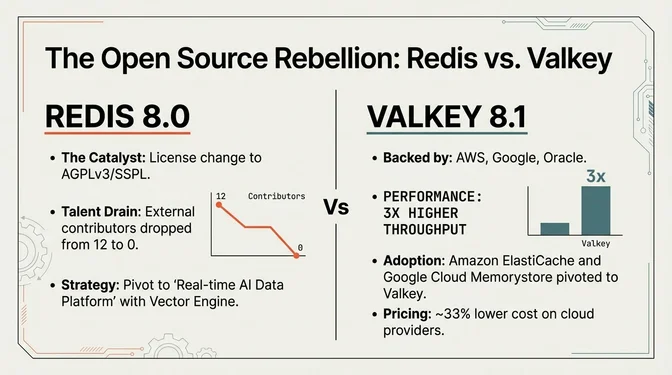
Redis learned that lesson the hard way. Redis 8.0 offered AGPLv3 as a license option, but the Valkey fork had already locked in AWS, Google, and Oracle, with benchmarks showing over 3x higher throughput. The damage from the 2024 license change was stark: the project went from 12 outside contributors handling 54% of commits to zero making more than five.
Security was brutal. Silk Typhoon breached the U.S. Treasury through a PostgreSQL injection chained with a BeyondTrust flaw. “MongoBleed” exposed credentials across 87,000 MongoDB instances. A researcher found 184 million passwords in an unprotected Elasticsearch database. The shakeout was real too. Fauna shut down in May, and the market is firmly rewarding consolidation. Cloud database spending hit $22.43 billion and is on pace for $62 billion by 2032.
Actions for 2026: Upgrade to PostgreSQL 18 for async I/O and UUIDv7. Try Valkey 8.1 as a Redis replacement. Patch MongoDB against MongoBleed if you’re running affected versions.
Database 2025 Timeline
January 2025
January 3
Apache Paimon 1.0.0
January 16
Snowflake Named DB-Engines DBMS of the Year 2024
January 18
Apache Hudi 1.0
January 20
Azure Database for MariaDB Retirement Approaches
January 21
MySQL 9.2 Innovation Release
February 2025
February 13
PostgreSQL CVE-2025-1094 Disclosed
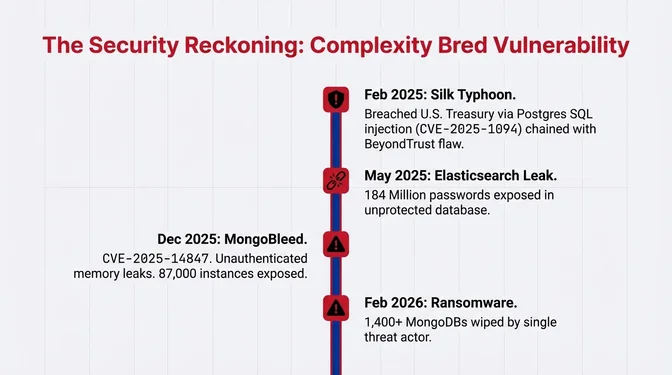
psql client. Exploiting BeyondTrust’s CVE-2024-12356 required chaining this vulnerability to achieve RCE. Chinese hacking group “Silk Typhoon” (APT27) had used these chained vulnerabilities to breach BeyondTrust Remote Support SaaS, affecting 17+ enterprise customers including U.S. Treasury Department workstations.March 2025
March 4
Weaviate Launches AI Agents
March 24
Apache Flink 2.0
March 25
PlanetScale Vectors GA
March 28
Valkey Search RC1
March 31
Valkey 8.1 GA
April 2025
April 8
ScyllaDB 2025.1 LTS
April 15
InfluxDB 3 Core and Enterprise GA
Elasticsearch 9.0
MySQL 9.3
April 24
Supabase Raises $200M Series D
May 2025
May 1
Redis 8.0 GA with AGPL Option
May 6
OpenSearch 3.0
May 14
Databricks Agrees to Buy Neon for $1 Billion
May 22
184 Million Passwords Exposed in Elasticsearch
May 27
DuckLake Launch
Amazon Aurora DSQL GA
May 30
Fauna Shuts Down
June 2025
June 2
Snowflake Acquires Crunchy Data
June 4
CockroachDB 25.2 with Distributed Vector Indexing
June 11
Databricks Lakebase Public Preview
June 12
Milvus 2.6
June 17
TimescaleDB Rebrands to TigerData
ScyllaDB X Cloud Launch
June 20
Amazon Timestream for LiveAnalytics Deprecated
MongoDB 8.1 (Atlas)
June 30
DynamoDB Global Tables Multi-Region Strong Consistency
July 2025
July 8
Algolia Named Gartner Magic Quadrant Leader
July 9
Apache Polaris 1.0.0-incubating
July 10
Oracle Database 23.5 “AI” Update
July 22
YugabyteDB 2025.2 Preview
July 23
AlloyDB Omni for Containers GA
July 24
Valkey 8.1 on Amazon ElastiCache
July 26
Neon Agent Plan
July 29
Qdrant Edge Launch
July 31
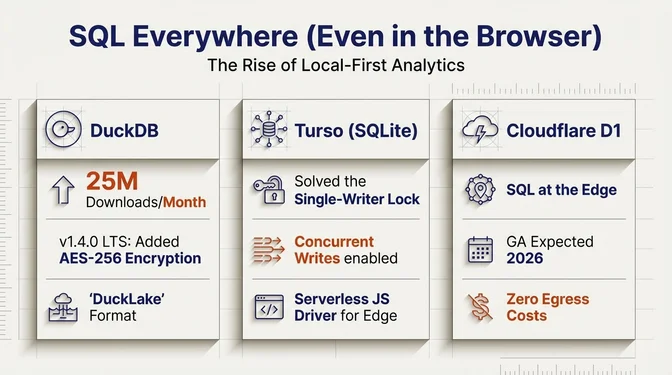
Turso Serverless JavaScript Driver
August 2025
August 8
Redis 8.2 GA
August 14
PostgreSQL CVE-2025-8714 and CVE-2025-8715
August 25
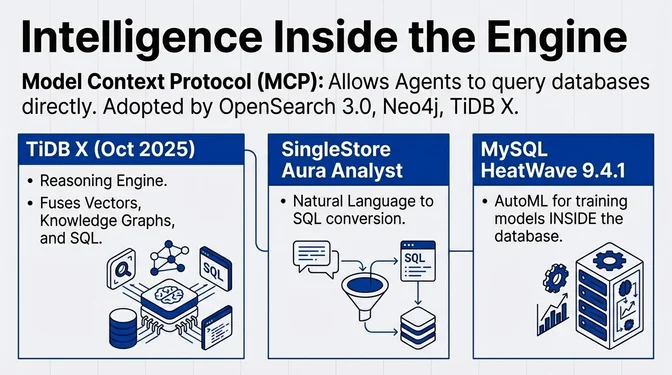
MySQL HeatWave 9.4.1 GA
September 2025
September 4
Neo4j Infinigraph
September 11
Apache Iceberg 1.10.0
September 16
DuckDB 1.4.0 “Andium” LTS
September 23
Algolia Agent Studio Launch
September 25
PostgreSQL 18.0
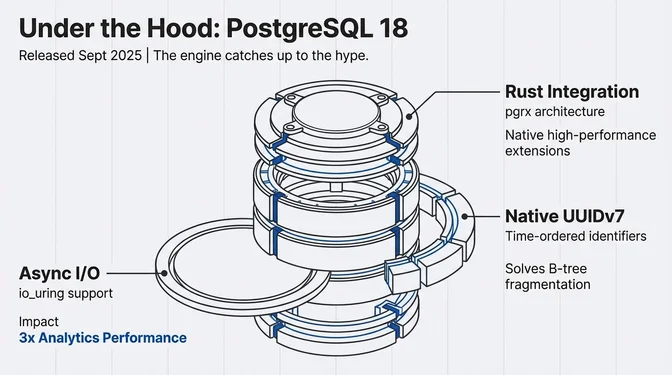
io_method parameter supporting worker, io_uring on Linux, or sync) promising up to 3x performance improvements in scan-heavy analytical queries, native UUIDv7 generation (resolving B-tree fragmentation from random UUIDv4s), OAuth 2.0 authentication, skip scan lookups, temporal constraints, virtual generated columns, and parallel GIN index builds. DB-Engines ranked PostgreSQL as March’s second-biggest climber and a top climber in 4 of the last 6 months.Delta Lake 4.0
September 30
MongoDB Vector Search for Self-Managed
Weaviate Search Mode GA
October 2025
October 1
Databricks Acquires Mooncake Labs
SingleStore Aura Analyst
October 3
Supabase $5B Valuation
October 6
QuestDB 9.1
October 8
PingCAP TiDB X
October 10
Apache Derby Enters Read-Only Mode
October 14
Oracle Database 26ai
October 16
AWS InfluxDB 3 Support
October 21
Couchbase 8.0
October 21–24
PGConf.EU 2025 — Riga, Latvia
October 25
TimescaleDB 2.23.0 and pgvectorscale
October 29
“The Case Against pgvector”
October 31
Cloud Database Market Reaches $22.4B
November 2025
November 13
PostgreSQL 18.1
November 18
SQL Server 2025 GA
sp_invoke_external_rest_endpoint for calling Azure AI Foundry/OpenAI/Ollama from within SQL, Intelligent Query Processing improvements, Optional Parameter Plan Optimization (OPPO), and Fabric Mirroring for near-real-time analytics replication to Microsoft Fabric OneLake in Delta Parquet format. Platform support expanded to RHEL 10 and Ubuntu 24.04 with TLS 1.3. Express edition now supports 50GB databases (up from previous limits). Microsoft has hinted at AI-assisted query optimization and natural language query features in future releases.November 19
Azure HorizonDB Unveiled
November 2025
Gartner Magic Quadrant for Cloud Database Management Systems
November 25
Qdrant 1.16
November 28
Prometheus v3.8.0
November 30
AWS re:Invent 2025
December 2025
December 1
Pinecone Dedicated Read Nodes
December 2
Amazon S3 Tables Replication and S3 Vectors GA
December 10
MongoDB CVE-2025-14847 “MongoBleed”
December 17
AWS Aurora PostgreSQL 18.1 Preview
December 18
AlloyDB Managed Connection Pooling GA
January 2026
January 8
Snowflake Acquires Observe for ~$1 Billion
January 16
ClickHouse $400M Series D and Langfuse Acquisition
January 20
Oracle Critical Patch Update
January 26
DuckDB 1.4.4 LTS
January 27
Oracle 26ai GA On-Premises
January 31
FOSDEM 2026 Databases Track
February 2026
February 2
1,400+ MongoDB Databases Ransacked
February 4
MariaDB Q1 2026 Maintenance Releases
February 9
Databricks Completes $5 Billion Funding Round
Database 2026 Watchlist
1. PostgreSQL 19
When: September 2026
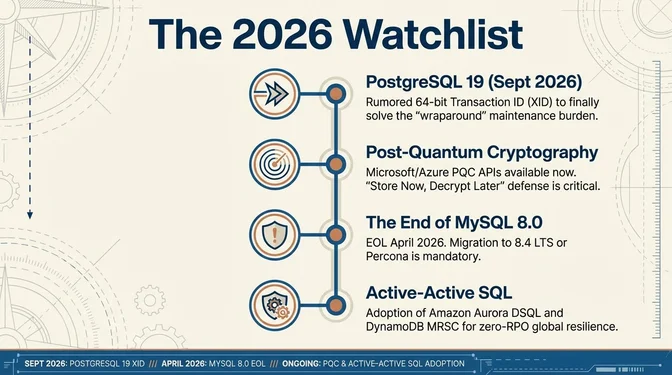
Context: Development continues with rumored 64-bit Transaction ID (XID) to solve decades-old “transaction wraparound” issue—a critical maintenance burden for massive Postgres clusters. May also include built-in pgvector indexing merged into core. Adoption of Rust via pgrx will grow for high-performance extensions. PostgreSQL MD5 authentication, deprecated in version 18, faces removal as SCRAM-SHA-256 becomes mandatory.
Action: Track PostgreSQL 19 development. Plan upgrade from PostgreSQL 17 or earlier given PostgreSQL 13 is now EOL.
2. Valkey 9.0 and Redis Competition
When: Q1-Q2 2026
Context: Valkey 8.1 achieves 28% lower memory usage than Redis while cloud providers offer 33% lower pricing. Redis Software 7.2 (based on BSD-licensed Redis OSS 7.2) reaches EOL Feb 28, 2026, forcing migration decisions. Valkey patched security CVEs in 9.0 release candidates.
Action: Plan Valkey migration before Redis 7.2 EOL. Benchmark Valkey 8.1 against Redis 8.2 for your workload. Consider cloud provider pricing differences.
3. Snowflake Postgres GA
When: H1 2026
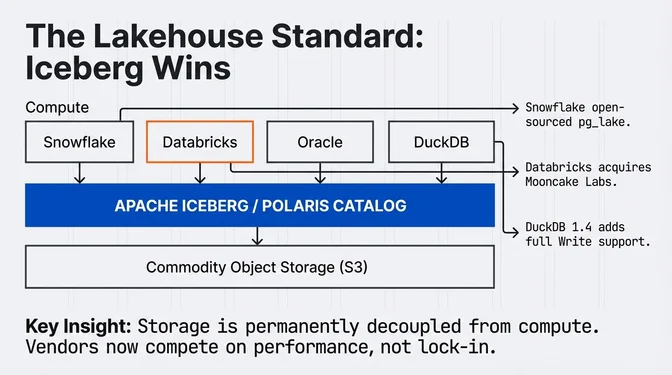
Context: Following Crunchy Data acquisition (estimated ~$250M), Snowflake Postgres is in private preview. Snowflake also acquired Datometry for SQL dialect conversion tools. Snowflake open-sourced pg_lake allowing PostgreSQL databases to query Iceberg tables in S3 directly, effectively turning every Postgres instance into a potential Lakehouse node.
Action: Sign up for Snowflake Postgres preview if using Snowflake for analytics. Test pg_lake for bridging operational Postgres with lakehouse analytics.
4. MySQL 8.4 LTS Transition
When: Throughout 2026
Context: MySQL 8.0 reaches EOL in April 2026 (ending with 8.0.46 per Oracle’s release notes). MySQL 8.4 LTS expected to replace 8.0 as the Long-Term Support track. Oracle laid off dozens of MySQL engineers—up to 70 senior MySQL developers in September 2025, raising community concerns about Oracle’s commitment.
Action: Plan MySQL 8.0 to 8.4 LTS migration. Consider Percona Server for MySQL or MariaDB as alternatives given Oracle’s uncertain commitment.
5. Vector Database Consolidation
When: Throughout 2026
Context: With PostgreSQL 18, Oracle 26ai, and SQL Server 2025 all offering native vector indexing, standalone vector databases face uncertain futures. PostgresML, Hydra, and Voltron Data faced struggles or shutdowns—their “AI-on-Postgres” value propositions overtaken by the core Postgres project’s own rapid evolution. Expect at least one major acquisition (e.g., cloud provider buying vector DB startup). Purpose-built vector databases will narrow to specialized high-performance use cases as integrated solutions mature. M&A speculation includes Cloudera and Couchbase joining forces, and SAP HANA may spin off or get more open.
Action: Test whether pgvector or integrated database vector capabilities can replace standalone vector databases. For billion-scale embeddings, benchmark Pinecone, Milvus, and Qdrant. Watch for acquisition announcements.
6. Apache Iceberg Ubiquity
When: Now
Context: Apache Iceberg won the table format war. Microsoft Fabric, Oracle 26ai, Snowflake, and Databricks all offer native Iceberg read/write. DuckDB 1.4.2 gained full Iceberg write support (INSERT, UPDATE, DELETE). This forces vendors to compete on compute engine performance rather than storage format lock-in. Snowflake open-sourced pg_lake allowing PostgreSQL databases to query Iceberg tables directly.
Action: Standardize on Iceberg for new data lake workloads. Plan migration from Delta Lake or Hudi. Use pg_lake or similar tools to bridge OLTP and analytics.
7. Post-Quantum Cryptography in Databases
When: Throughout 2026
Context: Microsoft made PQC algorithms (like ML-KEM) generally available across Windows and Azure platform APIs, with hybrid PQC key exchange coming to the Windows TLS stack—databases running on these platforms can inherit PQC-capable TLS connections. Oracle 26ai features quantum-resistant encryption. “Store Now, Decrypt Later” threats drive early adoption, and first operational mandates for Post-Quantum Cryptography appeared in 2025.
Action: Review PQC-ready database options for sensitive data. Check TLS configurations for quantum resistance. Databases on Windows/Azure can leverage platform-level PQC APIs for encrypted connections.
8. Aurora DSQL and Active-Active Distributed SQL
When: Throughout 2026
Context: Aurora DSQL’s active-active architecture with multi-Region strong consistency may set a new expectation for OLTP databases. DynamoDB’s multi-Region strong consistency with witness topology enables zero-RPO without full replica costs.
Action: Test Aurora DSQL for new globally distributed workloads. Consider DynamoDB MRSC witness topology for cost-effective global durability.
9. Open Table Formats and Streaming-Lakehouse
When: Throughout 2026
Context: Consolidation shifts from “which format” to “which catalog + governance + engine interoperability.” Iceberg 1.10, Delta Lake 4.0, Hudi 1.0, and Paimon 1.0 all reached maturity in 2025. Apache Polaris positions itself as an Iceberg REST-based catalog layer. Flink 2.0 pushes streaming-lakehouse patterns into a unified stack.
Action: Standardize catalog layer (Polaris, Unity, Gravitino). Test Flink 2.x + Paimon for operational-to-analytical pipelines.
10. S3 Tables and Storage-First Database Patterns
When: Throughout 2026
Context: S3 Tables added cross-Region Iceberg replication and Intelligent-Tiering. S3 Vectors reached GA scaling to 2 billion vectors per index with ~100ms latencies. Together they normalize a “storage-first database” pattern shifting workload gravity from specialized services into object storage.
Action: Test S3 Vectors for cost-sensitive vector workloads not requiring sub-10ms latency. Consider S3 Tables replication for cross-Region lakehouse consistency.
11. AI Agent Database Workloads
When: Now
Context: Over 80% of Neon databases created by AI agents. Neon’s Agent Plan offers custom resource limits for AI platforms. Gartner predicts AI agents will intermediate most B2B work by 2026—”Self-Driving” database capabilities moving from marketing hype to reality. Sub-second provisioning and scale-to-zero become essential. 74% of IT leaders expect budget increases in 2026 with AI readiness becoming core architectural mandate.
Action: Test Neon, Turso, or Supabase for AI agent workloads needing instant database provisioning. Add rate limiting and cost controls for agent-initiated database creation.
12. DuckDB and Embedded Analytics
When: Now
Context: DuckDB 1.4.0 “Andium” introduced first LTS release with AES-256-GCM encryption. With almost 25 million monthly downloads on PyPI. DuckLake launched as new lakehouse format. Turso’s breakthrough with concurrent writes overcame SQLite’s single-writer limitation.
Action: Try DuckDB for local analytics and data transformation pipelines. Consider Turso for edge and serverless applications requiring SQLite compatibility with write concurrency.
13. OpenSearch 3.x and Model Context Protocol
When: Now
Context: OpenSearch 3.0 delivered 9.5x faster performance with GPU-accelerated vector search and Model Context Protocol (MCP) support allowing AI agents to query search indexes. AWS announced GPU acceleration for vector operations at re:Invent 2025.
Action: Upgrade from OpenSearch 1.x (deprecated May 2025). Test MCP integration for AI agent applications. Consider GPU-accelerated indexing for large vector workloads.
14. Vector Search Quality and Correctness
When: Ongoing
Context: Using vector search for mission-critical tasks (medical, legal document retrieval) raises quality concerns—issues of drift, bias, and false positives in nearest-neighbor search need addressing. Research emerged in 2025 on “safe vector search”: algorithms to quantify uncertainty of vector matches and hybrid approaches that cross-verify with symbolic searches.
Action: Use hybrid search (combining vectors with keyword/BM25) as default pattern. Add uncertainty quantification for high-stakes vector queries. Cross-verify vector results with traditional search for critical applications.
15. Cloudflare D1 and Edge SQL
When: 2026
Context: Cloudflare D1 (essentially a hosted SQLite with Durable Objects) should reach GA—enabling SQL at the edge. **Turso** disrupted the market with $4.99/month for unlimited databases (500 monthly active limit), making database-per-tenant architectures 100-1000x cheaper. Turso’s serverless JavaScript driver uses pure HTTP communication via fetch(), working on Cloudflare Workers, Vercel Edge Functions, and Deno Deploy. Edge databases are becoming essential for low-latency AI applications.
Action: Try D1 and Turso for edge-first applications. Consider database-per-tenant architectures where latency matters.
16. Oracle-to-PostgreSQL Migration Wave
When: Now
Context: AWS Database Migration Service has helped customers migrate 1.5M+ databases. Drivers include zero licensing fees and estimated 30% lower TCO. Key tools: Ora2Pg (open source), AWS DMS (serverless), EDB Migration Toolkit (enterprise), pgLoader (up to 3TB/hour throughput).
Action: Plan Oracle-to-PostgreSQL migration for cost savings. Target PostgreSQL 18’s async I/O performance improvements that close the gap with proprietary databases.
17. Skills Evolution for DBAs
When: Throughout 2026
Context: DBAs in 2026 need SQL tuning skills alongside vector index management and ML model deployment. Expect new certifications like “Azure Vector Data Engineer” or “Certified AI Database Specialist.” Tools like PostGraphile and Prisma are improving GraphQL-to-SQL integrations—2026 might see a major DB provide a built-in GraphQL endpoint. Cockroach Labs reportedly postponed IPO plans, instead taking strategic investment from cloud partners.
Action: Upskill on vector search fundamentals, embedding models, and RAG architectures. Test GraphQL integrations for developer experience improvements.
Originally published by The Dev Newsletter. Republished under the Creative Commons Attribution 4.0 International license.